[ad_1]

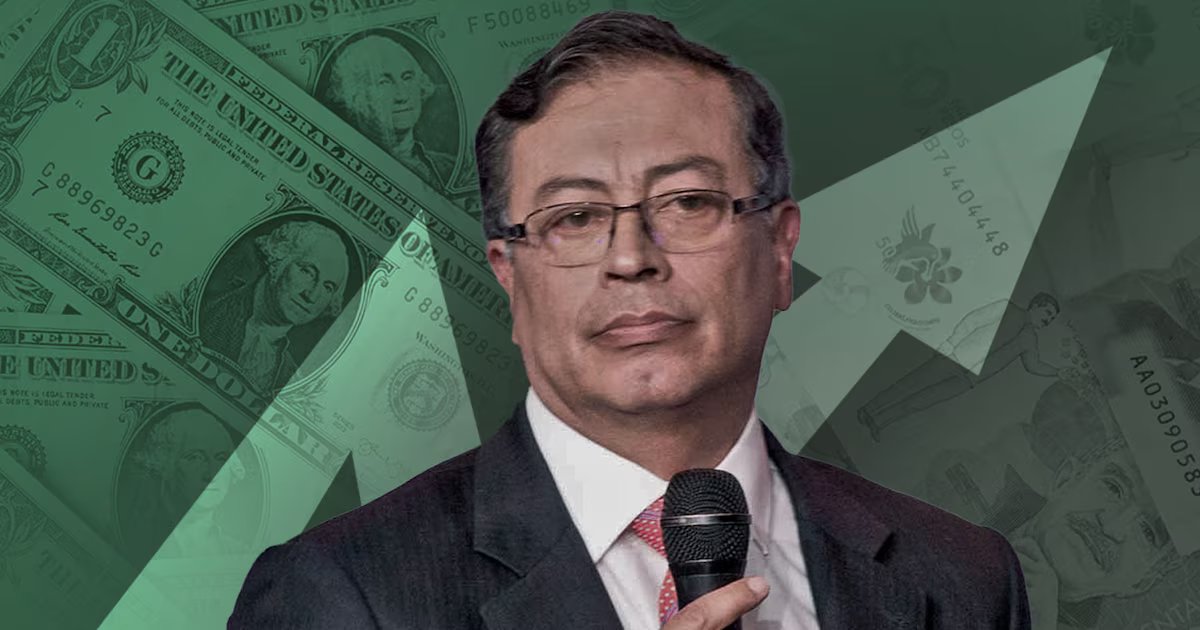
In a heated debate on social media about the future of Colombians’ pension savings, President Gustavo Petro responded on January 1, 2026, to strong critiques made by Mónica Higuera: former director of the Financial Regulation Unit (URF), who resigned after rejecting the government’s proposal to repatriate funds invested abroad, as confirmed by the Ministry of Finance.
Through his social media, the president defended his stance against Higuera’s criticisms. “Since the creation of Law 100, pension savings have been in Colombia,” the president stated, clarifying that these resources partially served to finance the returns on the individual accounts of workers and fund managers, in contrast to the ex-official’s view, which he considers unviable.
You can now follow us on Facebook and our WhatsApp Channel
In this context, Petro asserted that true change came with the emergence of financial intermediaries, which he associates with the “neoliberal model set by César Gaviria,” which, in his opinion, “distorted the central message of the Constitution: the Social State of Law.” He firmly criticized the policies promoted during Juan Manuel Santos’s government, asserting that there was a significant regression on this issue.
“Santos made a huge mistake by allowing by decree… the savings of workers to be taken abroad without their consent and at risk,” the head of State expressed, emphasizing the need for a gradual transition in the return of capital. “You are right that the return of resources to the country cannot happen all at once but should be gradual,” the president acknowledged to the former official, who warned about the risks involved.

Regarding the role that repatriated funds should play, Petro defended long-term investment in projects as priorities for national development: “Where should we invest? In necessary long-term investments for the country: railways, central and submarine fiber optics, and the construction of new housing as well as improving existing ones. This is referred to as Fixed Capital,” declared the head of State in his extensive message.
Higuera, for her part, presented her technical reservations regarding the official plan, addressing the president directly in messages, “There must be technical, economic, legal, and actuarial simulations (…). But bringing money for the sake of bringing it is not responsible towards Colombians,” asserted the former URF director, who reiterated her disagreement with the proposal to repatriate 125 trillion pesos to the nation’s coffers within six months.
“That (the idea of bringing back 125 trillion in six months) was a fatal mistake. Because of not doing it that way, I had to leave,” revealed the ex-director, emphasizing the importance of investment diversification as a mechanism to protect workers’ savings. “Diversification protects capital,” stated the former official, who also highlighted that the return of these funds could have macroeconomic effects and market impacts that must be calibrated.

In justifying her departure from the organization, the former official argued that she did so based on technical criteria and a commitment to financial stability. “My technical expertise was dedicated to safeguarding and protecting public savings and the stability of the financial system,” she asserted on her X profile, receiving significant support for her position, which often contrasts sharply with that advocated by the president in his message.
Higuera believed that “we all want the well-being of workers, savings, and our economy,” but she specified that “this is achieved not just through good intentions, but with technical criteria.” Nonetheless, she appreciated Petro’s willingness to listen to different perspectives and emphasized the need for transparency and citizen participation in a matter of high relevance for the current government’s fiscal policy.

“The first point of agreement is that the normative projection must be done with transparency and citizen participation. I commend your willingness to create working groups and listen. Progress is made more effectively this way,” the official said, concerning a topic raised by Finance Minister Germán Ávila, detailing the government’s plans with nearly $250 trillion in funds that are abroad.
“These resources invested abroad can be brought back to ensure the financing of these projects,” declared Minister Ávila, explaining that the country has rail projects worth $156 trillion, road initiatives totaling $101 trillion, and maritime, fluvial, and aerial infrastructure works costing around $35 trillion; reasons why fresh resources are needed to start executing all of these initiatives.
[ad_2]