[ad_1]

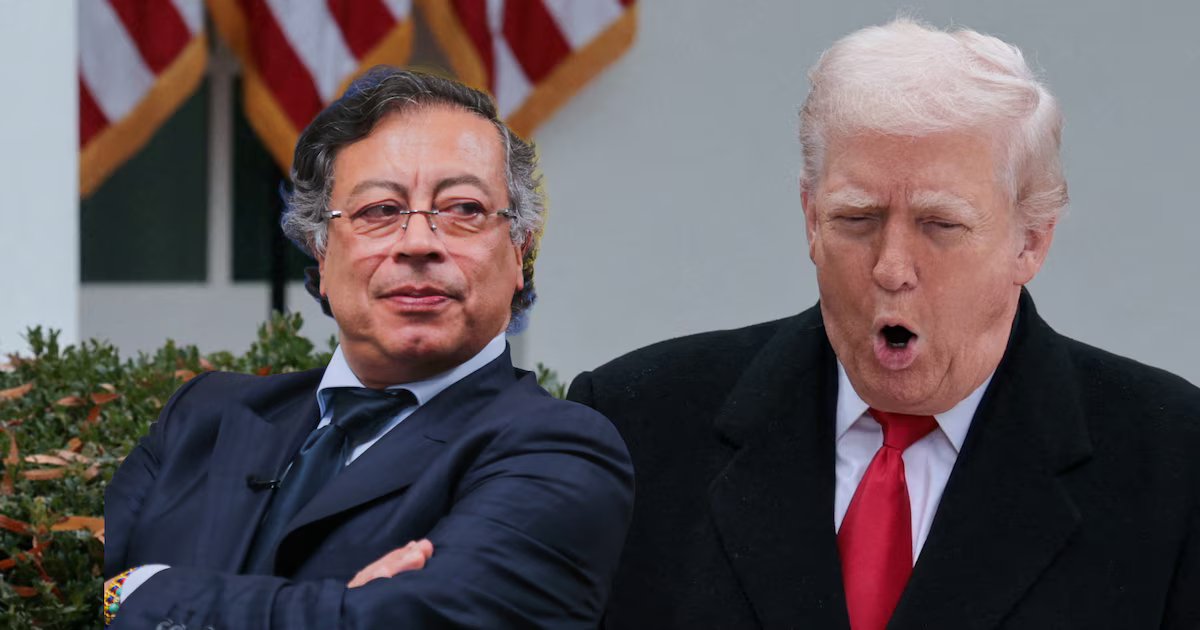
In a new message on his social media, on the night of Sunday, January 4, 2026, Colombian President Gustavo Petro sparked a strong international backlash after stating that the United States has become “the first country in the world to bomb a South American capital in all of human history,” referring to the military operation that led to the capture of Venezuelan dictator Nicolás Maduro in Caracas.
The president compared the attack to historically significant events like the Nazi bombing of Guernica, Spain, and warned that this episode will mark the collective memory of South America for generations. In his message, Petro asserted that “friends do not bomb” and raised alarms about the political, social, and geopolitical consequences left by the U.S. military intervention in the region.
Now follow us on Facebook and on our WhatsApp Channel
In one of the most striking segments of his statement, Petro indicated that the bombing of Caracas leaves a historical wound that is hard to heal. “What a terrible medal that is because for generations South Americans will not forget,” he wrote, while rejecting any logic of revenge as a response to the events.
The head of state emphasized that violence motivated by resentment does not lead to profound transformations, using the term “vendetta” to illustrate the risks of perpetuating cycles of hatred. According to Petro, “revenge does not make revolutions,” as these types of responses ultimately destroy social fabric and deepen internal conflicts.
In his reflection, the president drew an analogy with the dynamics of violence in popular neighborhoods, pointing out that young people end up fighting each other out of revenge impulses, which, in his opinion, shows that vengeance “kills the heart” and does not generate structural changes.

Beyond the immediate impact of the military operation in Venezuela, Petro focused a significant portion of his message on the need to rethink international relations in Latin America. In this context, he criticized the historical dependency on external alliances and called for prioritizing regional integration as a core aspect of sovereignty.
“Latin America must unite or it will be treated as a servant and slave rather than as the vital center of the world,” asserted the president, insisting that the region must strengthen its political, economic, and commercial ties before looking to foreign powers.
Petro also stated that alliances with powers like China and Russia have not been sufficient, and indicated that the priority should be a solid Latin American integration. In this regard, he mentioned Brazilian President Luiz Inácio Lula da Silva, suggesting that the fundamental alliance must be among the countries of the continent.

In his statement, the president criticized the current functioning of the Community of Latin American and Caribbean States (Celac), considering that absolute consensus limits strategic decision-making. According to Petro, this mechanism allows some governments to align with foreign interests, undermining a unified regional stance.
“There is always a president who prefers to remain a slave to foreign governments,” wrote the president, while calling to gather the region’s leaders to redefine Latin America’s political priorities in light of the new geopolitical landscape.
This new statement adds to a series of previous messages where Gustavo Petro labeled Nicolás Maduro’s capture as a “kidnapping” executed by U.S. troops, who stormed in the early morning of Saturday, January 3, in Caracas and arrested the head of the Venezuelan regime along with his wife, Cilia Flores.

Although the president has not explicitly condemned Maduro or his actions, despite repeated allegations of human rights violations, he has insisted that “military intervention undermines Venezuela’s sovereignty” and disrupts the political balance on the continent.
Petro also used harsh terms against U.S. President Donald Trump, whom he holds responsible for promoting an offensive that, according to Washington, aims to end a political era in Venezuela, but which, for the Colombian leader, sets a historically risky precedent for Latin America.
[ad_2]