[ad_1]

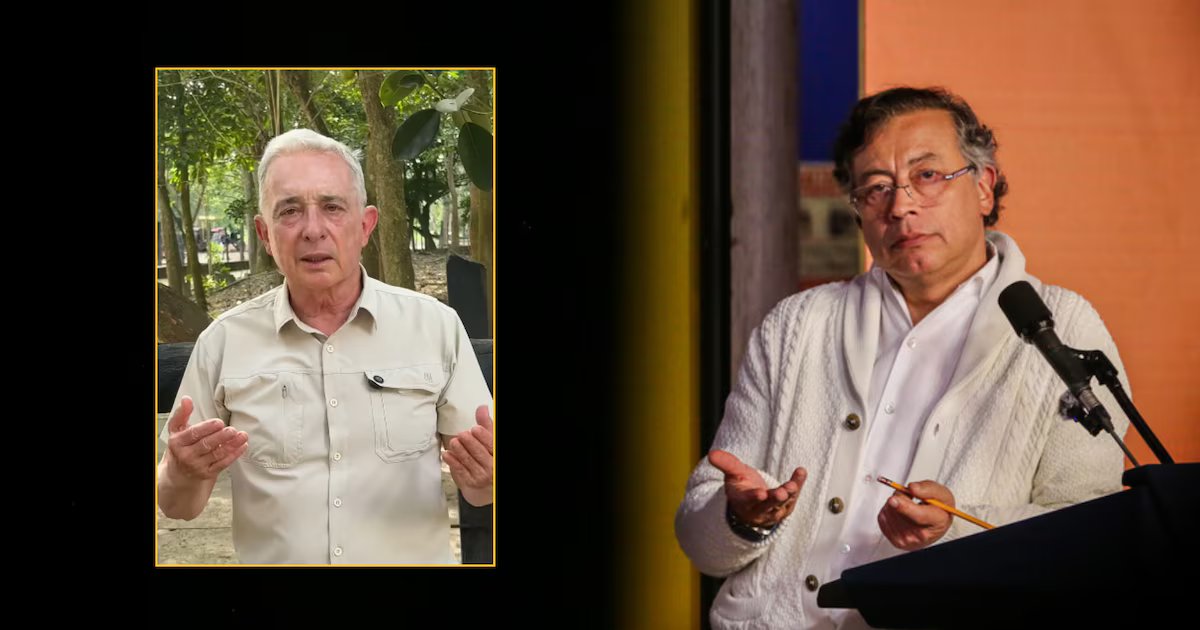
The recent actions by the national Government in the international market continue to spark intense exchanges between President Gustavo Petro and opposition sectors.
In fact, just two days after the Executive announced the issuance of external debt bonds exceeding $4.9 billion, which immediately affected the value of the Colombian peso, President Petro defended his strategy despite criticisms from Álvaro Uribe.
You can now follow us on Facebook and on our WhatsApp Channel
The exchange began when, the day before, Uribe accused the Government of generating “unsustainable deficit and debt.” The former president claimed that the Executive took on external debts amounting to $11 billion, of which $6 billion had an exorbitant interest rate of 13.5%.
According to Uribe, the combination of new debts, public spending, and remittances has led to a decline in the dollar, adversely affecting export sectors, particularly “the flower growers and call centers,” which are unable to adjust prices against global competition.

“The Petro dollar, another blow to workers. The desperation to elect Cepeda with unsustainable deficit and debt has led the Government to borrow another $11 billion, $6 billion of which carries an exorbitant interest rate of 13.5%. These dollars, coupled with bureaucratic waste, remittances from abroad, and 80% of the world’s coca production, have driven the dollar down to levels that seriously harm labor-intensive export sectors,” wrote the former president.
In his response, Petro refuted Uribe’s claims regarding the percentages and defended the acquired loan.
“Former President Uribe, you state several untruths in your text. You claim that we took a loan at 12%, but that’s incorrect; we borrowed in dollars at 5.9%. As a result, and due to the appreciation of the peso against the dollar, this ends up being much cheaper than borrowing internally in pesos at 13.5%, which frees up internal resources for investment. You assert that we’ve increased national debt; not at all, that money is used to pay short-term and more expensive debts incurred during your previous administration,” wrote the president.
In his message, the president took aim at Ivan Duque’s government, asserting that many of the Executive’s decisions have been influenced by the “inheritance” left by the previous administration.

“What consequences does our action have? It lowers the payment installments of future governments’ debts. We’re refinancing the debt to make it more manageable for the next administrations, unlike what your ally Duque did. Responsible governments do this—pay off expensive, short-term debts with cheaper, long-term ones. This process is referred to as ‘rollover’ in English, and you engaged in it as well, which is a responsibility,” he wrote.
Gustavo Petro asserted that Iván Duque also indebted the country to benefit the wealthiest companies rather than the citizens.
“Your ally Duque, for instance, left us two short-term debts: an IMF debt of over USD $5 billion, greater than the one we just took, but it wasn’t to pay off older debts. Instead, it was used to subsidize the payroll of the largest private companies in the country, an unconstitutional subsidy you are all accustomed to; to pay the payroll of the owners of the 130 largest companies in the nation; that debt left to the nation has now been fully paid by my government,” he continued.
Finally, the president stated that the goal of the new external bond is to improve the country’s cash flow while also addressing older debts like the fuel subsidy, which had a deficit of 70 billion pesos in 2022.
“We’re not borrowing to increase spending, but to pay off the debts that you left to the nation. We’ve already settled the FEPEC debt, and since the Colombian peso has appreciated against the dollar, I inform you and the nation that we will begin lowering gasoline prices,” the president concluded.
[ad_2]